Franklin Place? Franklin Who?
Franklin Place is named for John Franklin Miller (1862-1936), a mayor of Seattle (1908-1910), a Washington congressman (1917-1931), and a racist who favored eugenics, the same ideology of white purity as Germany’s Nazi party. I say we give Franklin Place the old King County treatment.
In 2005, our county replaced its namesake adopting Martin Luther King, Jr. (1929-1968) in lieu of William Rufus de Vane King (1786-1853), a Vice-President of the United States, and a slaveholder. We effectively got a new king.
As for renaming Franklin Place, I am all for honoring Benjamin Franklin. He is not a lightning rod for racism, bigotry or other despicable behaviors. He even lent his name to Benjamin Franklin McAdoo, Jr., the African-American architect of the recently landmarked Queen Anne Pool. It won’t cost a dime to rename it Franklin Place for Benjamin Franklin and honor someone worthy of such a beautiful place. The sign can stay the same.
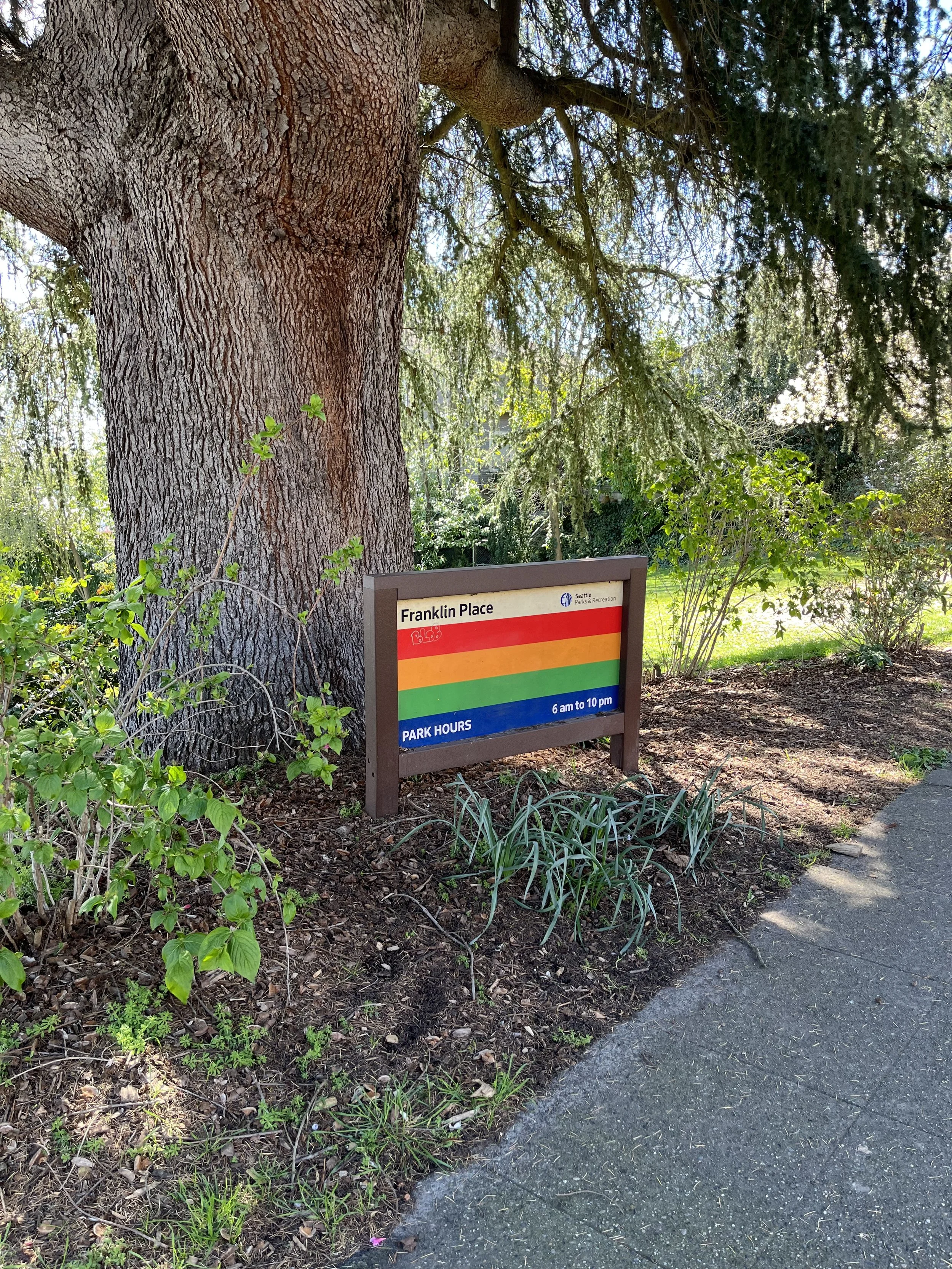
The sign at Franklin Place and the deodar cedar tree. Photo: QAHS.
Franklin Place is one of three parks that make up Kerry Park, an administrative unit of Seattle Parks and Recreation. Kerry Overlook that Albert S. and Katherine Kerry gave to the city in 1927 is on the north end. I think of it as the top of the park. It's the one that attracts millions of visitors every year who come to enjoy the phenomenal views of Elliott Bay, the Olympic Mountains, downtown, the Space Needle and Mt. Rainier. Below it, the middle section includes a playground and a flat zone along W. Prospect St. It was named Franklin Playground in 1909. The southern or bottom section of the park on the south side of Prospect is where you find Franklin Place, a name it acquired in about 1983.
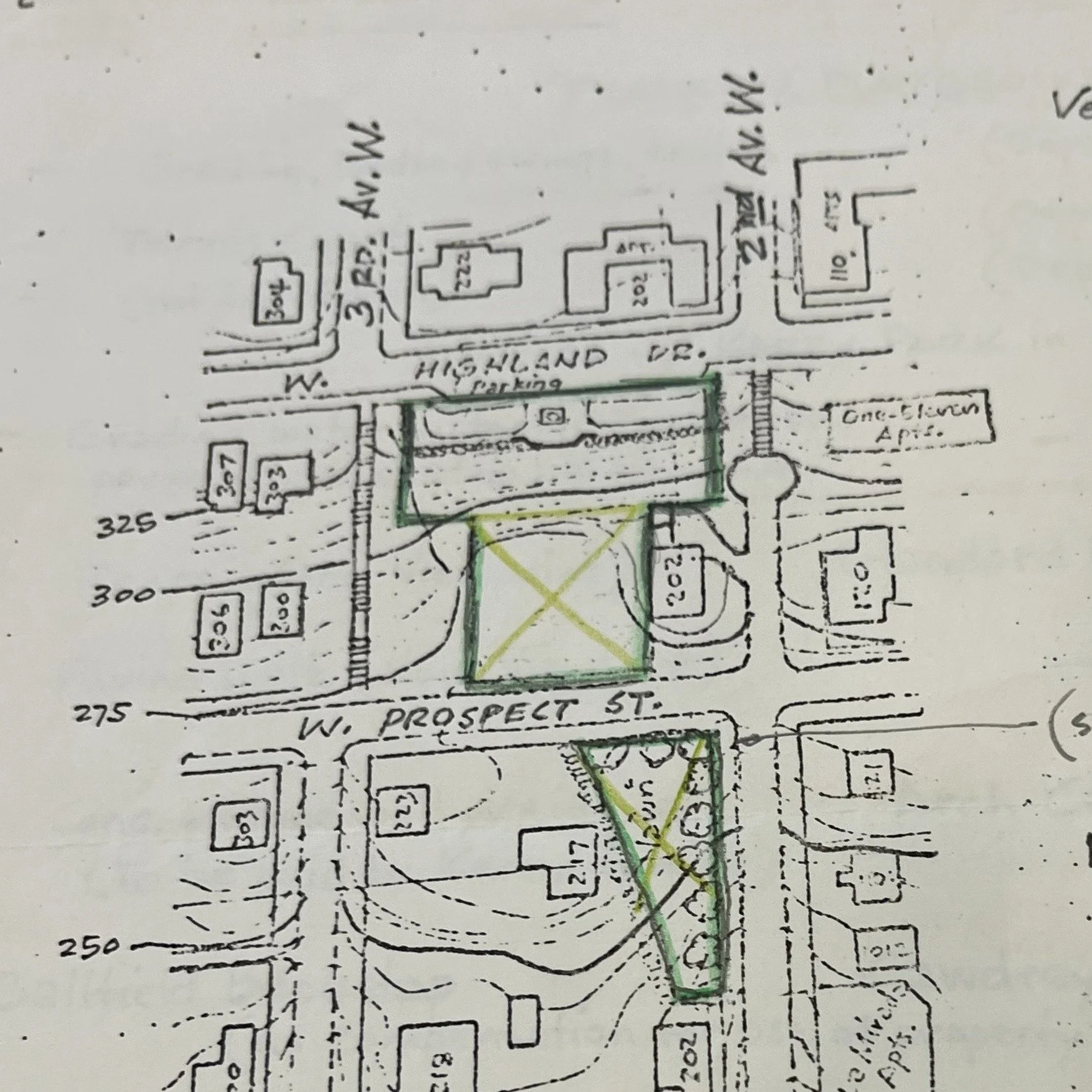
Upper rectangle Kerry Overlook; Upper X Franklin Playground; Lower X Franklin Place. Don Sherwood Parks History Files. Seattle Municipal Archives.
Franklin Place swoops down the steep incline from Prospect St toward Kinnear Place. A beautiful deodar cedar marks the intersection with 2nd Ave W. Other trees flanking its edges, a big lawn, and three benches are all the park has to offer. The two benches at the top face south parallel to Prospect and offer views almost as great as from the overlook behind them. Both benches are good for stunning views of Mt. Rainier on a sunny day. The bench at the park bottom faces uphill at an angle to the street. Seated there a visitor looks straight at 111 W. Highland Drive, one of the most notorious buildings in neighborhood history. Check out: "United South Slope Residents" Save Kerry Park.
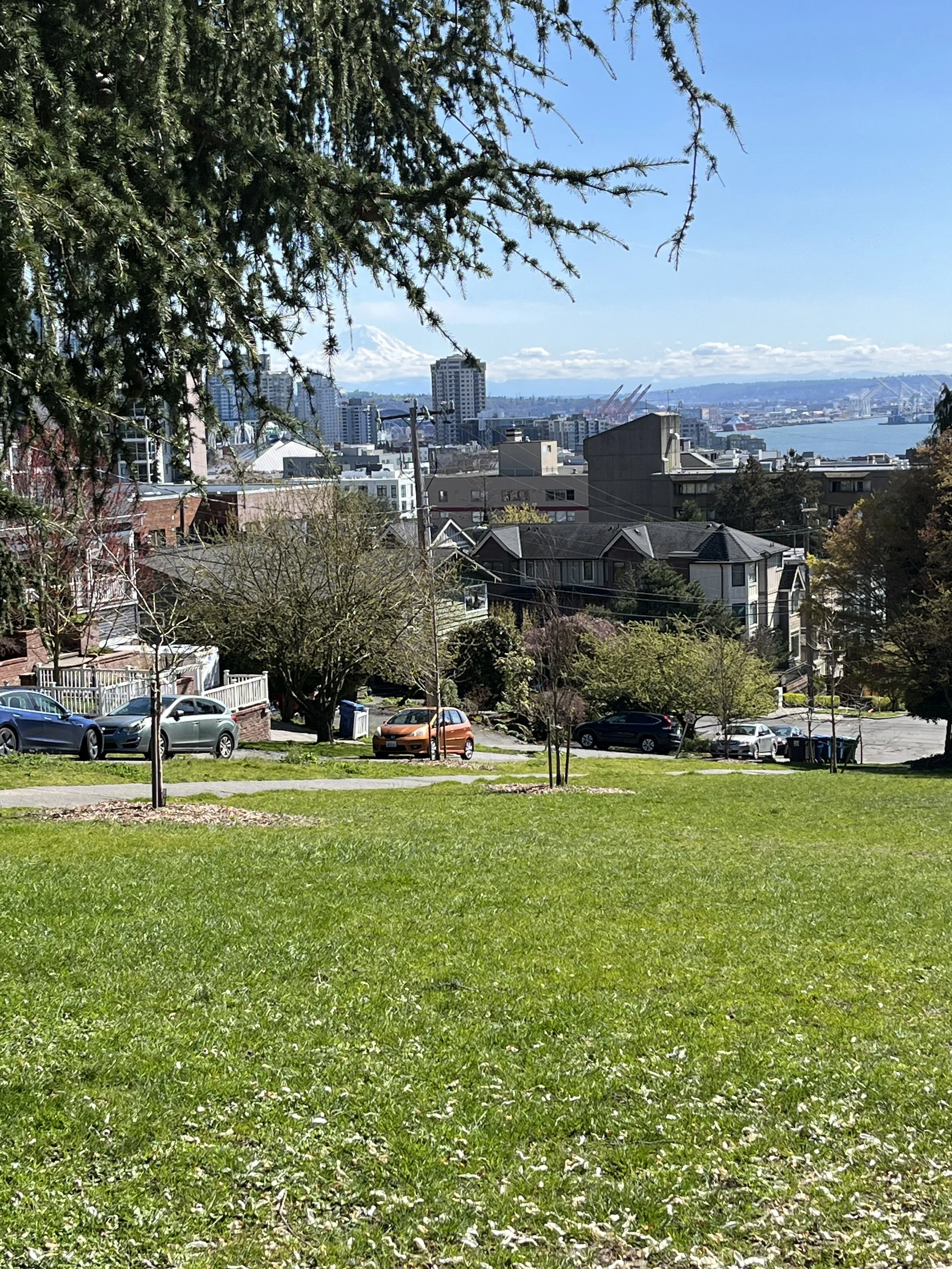
Franklin Place looking southeast from a bench. Photo: QAHS.
Queen Anne: A Community on the Hill, the Queen Anne Historical Society’s book, reports on the creation of the park.
In the twentieth century, midway down the south slope of Queen Anne Hill an ample spring gushed forth. George Kinnear had piped this spring in the 1880s as the water supply for his home and gardens, as well as Delamar, his nearby guest house. In 1904, wishing to protect the spring and the storage tank beside it from private and street development, the Kinnears deeded the site to the City of Seattle “as a park forever,” reserving the right to “maintain or rebuild any part of the system.”
Based on records at Seattle Municipal Archives and the amazing help of the city’s Reference Archivist, I can say our book pretty much gets it right. The opening bit about the twentieth century is off as is the reference to the De La Mar. The Kinnear family had capped the spring in the 19th century in about 1888 when they built their house. In 1908, they used the water system for the De La Mar at First W. and Olympic Place. They built it for their guests at the 1909 Alaska-Yukon-Pacific Exposition (AYP), our city’s first World's Fair. Also, the Kinnear’s did not write the building’s name Delamar.
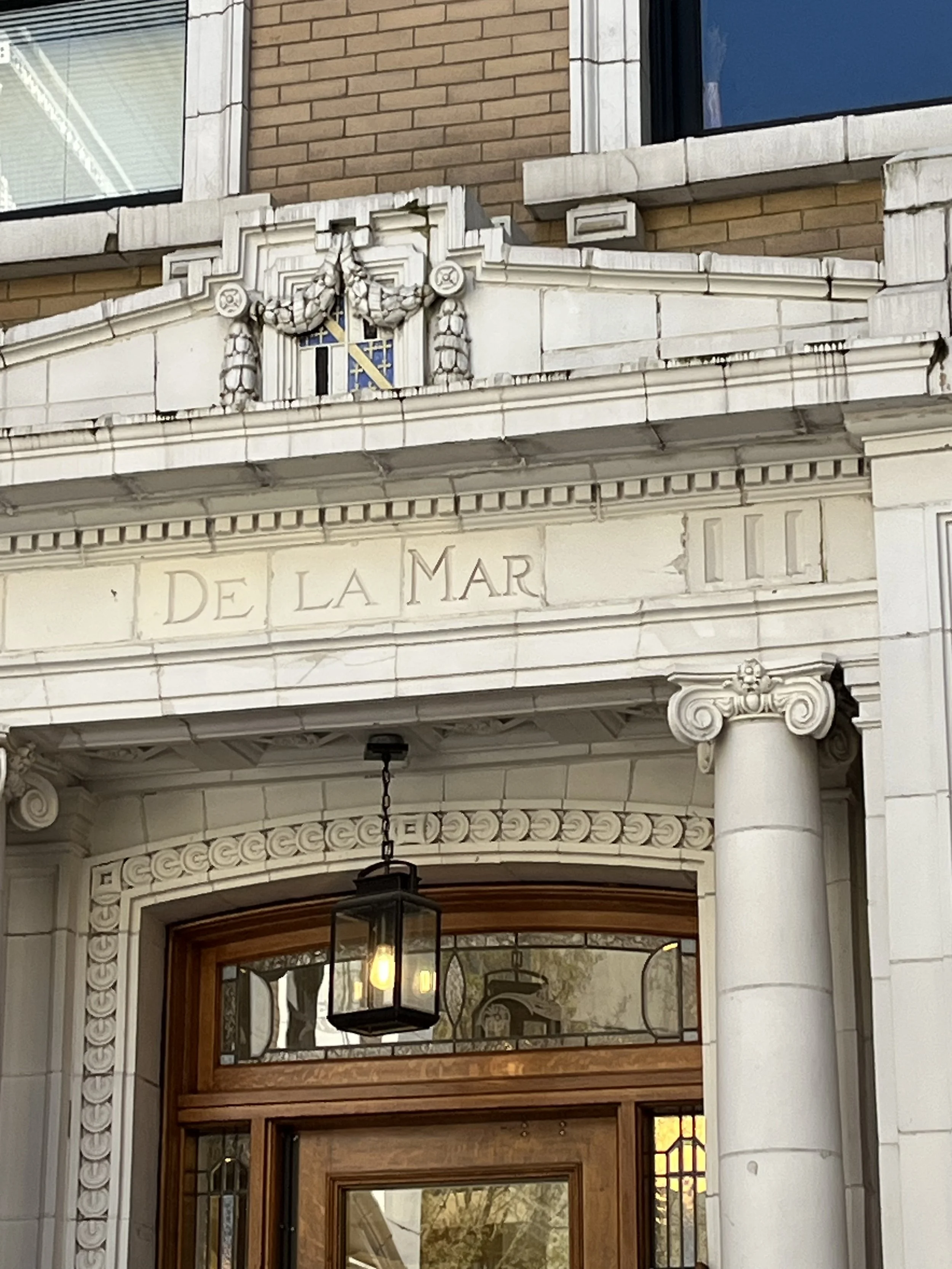
Terra cotta lintel of the De La Mar, now an apartment house, it is listed on the National Register of Historic Places. Photo: QAHS. 2026.
At the time of their 1.4 acre 1904 donation George and Angie Kinnear probably owned all of what we think of as lower Kerry Park and which now sports the name Bayview-Kinnear Park. Their donation consisted of the middle part of the block where they had that tank the gushing spring filled. They retained the three lots on the west side of the block along Third Ave. W., and probably the three lots on the east side which they may have sold in 1911 to the Sparger family for their house at 202 W. Prospect St. along the 2nd Ave W. cul-de-sac. (City of Seattle: Historic Resources Survey).
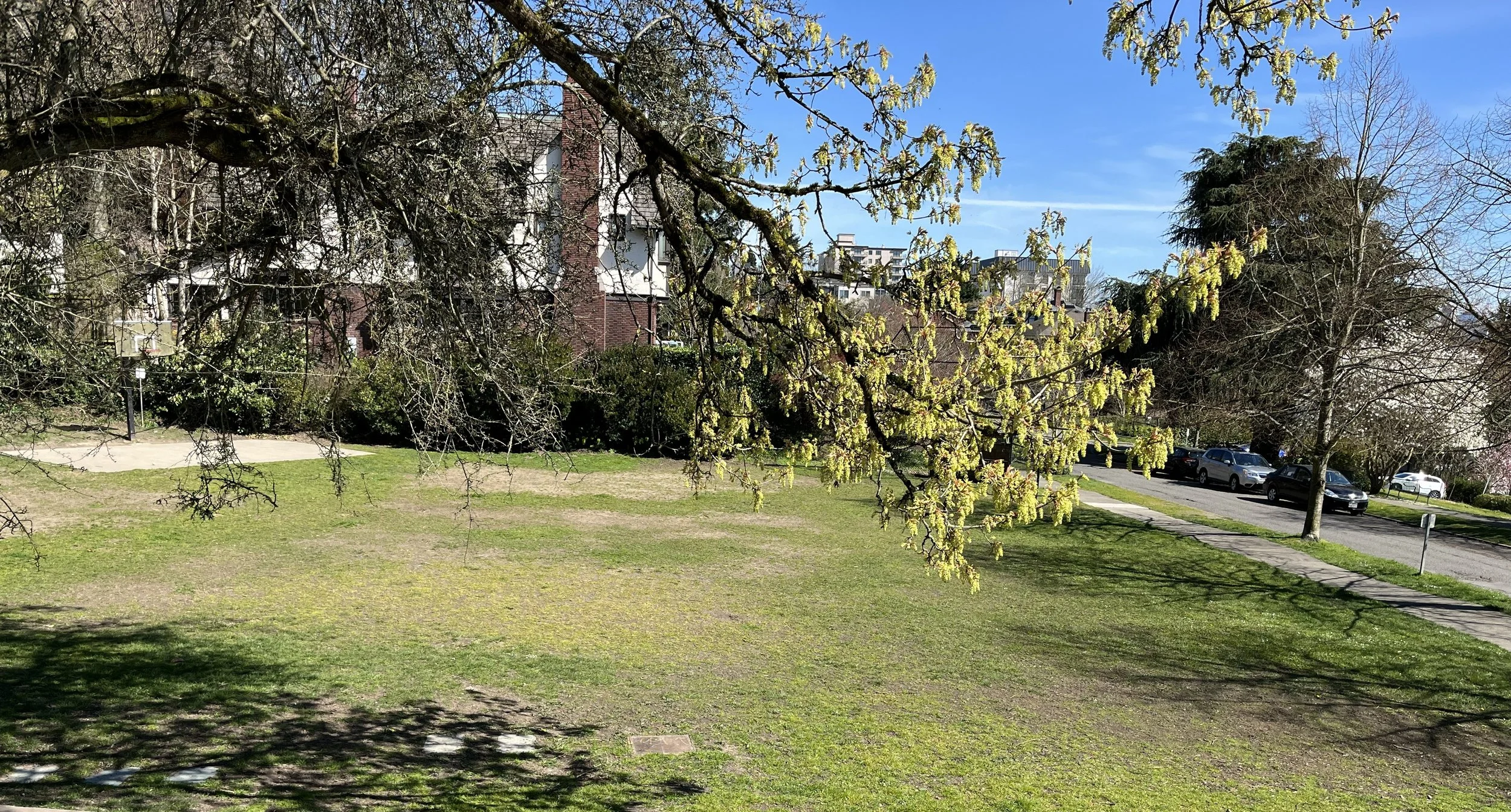
Water tank site looking east from play area. Sparger House in rear. Photo: QAHS.
The Kinnear donation also included the stretch of open land that we now call Franklin Place and under which the water from the tank ran in pipes to their 1888 home at 801 Queen Anne Ave N. (Temperance Ave then). The change in elevation provided enough pressure for the water to reach all three stories of the house.
Parks were clearly in the Kinnear blood. Their 1889 donation of 14 acres on the bluff overlooking Elliott Bay, Seattle’s second park, could have been enough. In 1904 though, Seattle was ablaze with interest in parks. That year the city council adopted the Seattle Park Plan following its 1903 submission by John Charles Olmsted of the Olmsted Brothers. Adding yet another park to the Kinnear list of donated spaces might have naturally occurred to them. George served on the board of the Seattle Park Commissioners, the one that hired the Olmsted firm.
Don Sherwood notes that the Kinnears retained the three lots on the west side of the site. Following the death of George and Angie, their oldest son Charles inherited the three lots and the family home on Queen Anne Ave where he eventually lived. I was surprised to learn that this too became part of the Franklin Place story.
Sherwood, the park historian, notes that for some crazy reason no one can explain, the Board of Park Commissioners in their annual report for 1909 announced out of the blue that they had named the Kinnear donation Franklin Playground for Mayor John Franklin Miller. For all we know, the commissioners honored Miller because he lived a block away at 108 W. Prospect, a house that still stands.
Just as no one knows what motivated the commissioners, no one can explain why they chose the mayor’s middle name for the park. I am guessing the mayor used Franklin to distinguish himself from his California uncle of the same name who had served in the United States Senate. I do know for sure that unlike George Kinnear who effectively shut down the anti-Chinese riots of 1887, Miller held strong anti-Asian views and believed in white superiority. He expressed his racist views before Congress in a 1924 speech which is documented in the Congressional Record(1).
Now, the Franklin Place story gets really messy. In 1956, as he grew old Charles Kinnear donated his family home and property to the First United Methodist Church for a retirement home. His donation included those three lots on the west side of Franklin Playground. Following the 1959 demolition of the house, the church built Bayview Manor (now Bayview Retirement Community) on the site.
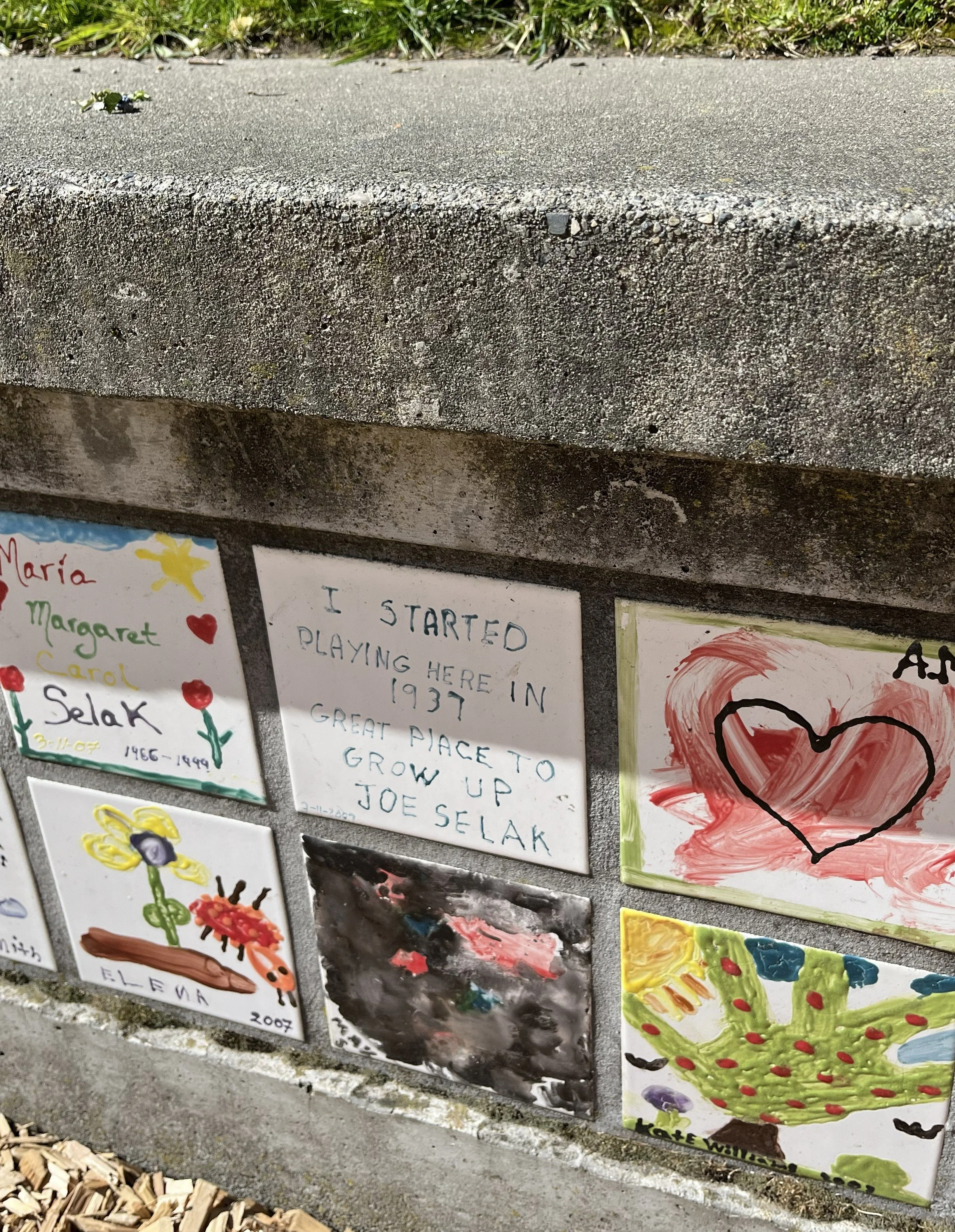
Joe Selak’s tile at Bayview-Kinnear says it all. Photo: QAHS.
Later in 1968, Forward Thrust, bond issues for improving the quality of life in the city and county, had provisions for “West Queen Anne Neighborhood Parks.” A small park at the West Queen Anne Elementary School (5th and W Galer) was among them. Building the park got delayed until 1981 by which time the school district had decided to abandon the school. Then the money got transferred to Franklin Playground, but again nothing happened. Finally in late 1982, Seattle Parks requested the gift of the three empty lots on 3rd Ave W. from the First United Methodist Church which, with the Kinnear family agreeing, gladly gave the land. Seattle Parks then renamed it Bayview-Kinnear Play Area and built a playground.
According to Don Sherwood, some neighbors were unhappy to lose the Franklin Playground name. Seattle Parks appeased them by transferring the name to Franklin Place. In the end, in 2006-2008 Seattle Parks rebuilt the Bayview-Kinnear Play Area and renamed it Bayview-Kinnear Park.
I have long been intrigued by the flat playfield below Kerry Park, the Kinnear’s source of water, and that Franklin name. Now that I know a lot more about it, I am betting that today’s neighbors, informed about Miller's racism and his embrace of eugenics (2), will join me in petitioning Seattle Parks to change the pocket park’s name. Let’s go for (Benjamin) Franklin Place. It won’t cost a dime!
Miller supported racist policies in Congress, claiming to his fellow House members that "No greater tragedy can befall an American girl than to become the wife of a Japanese," and "There is not a scientist, an alienist, a scholar of the world who does not believe in the preservation of racial purity."[1]
In 1886, Kinnear was captain of the Home Guard, its highest-ranking officer, and was integral in subduing the mobs during the anti-Chinese riots of 1885-86, which prevented the forcible eviction of Seattle’s Chinese residents.