
Postscript & Corrections to the Obituary for the Clise House
Accurate history can be elusive. When we uncover errors, we do our best to correct them. The article “Obituary for the Clise House” which appeared on June 8, 2026, had errors which the current owners quickly brought to our attention. This postscript addresses them and sets the record straight.**
__________________________________________________
Even when necessary, demolishing an old house is sad. This time, it is the house built in 1904 at 501 W. Highland Drive on a brick foundation.
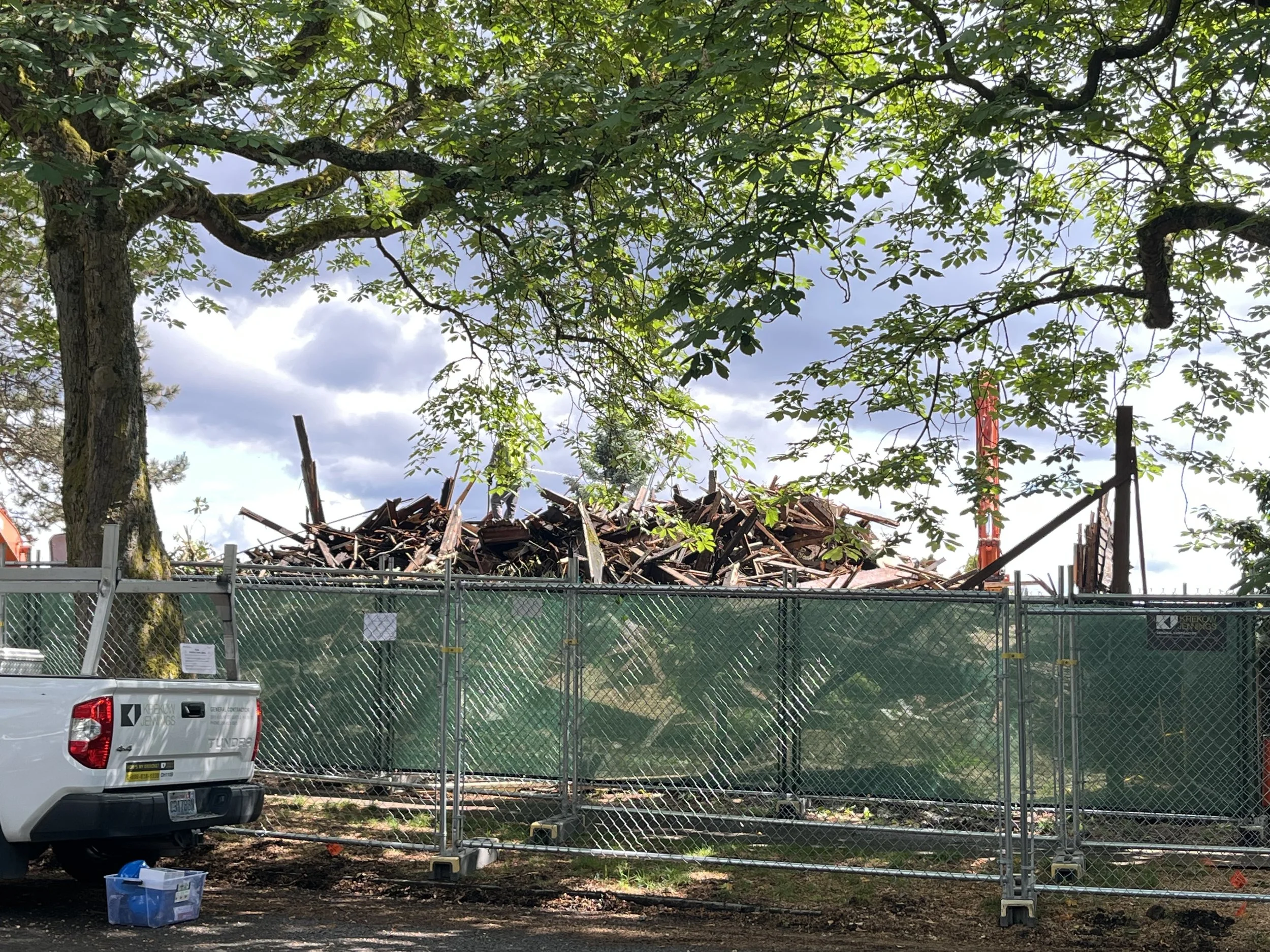
Coming Down on May 27, 2026. Photo: QAHS.
A fire raged through the house on the early afternoon of November 30, 2021. A handyman working as an unlicensed electrician was replacing outlets throughout the house when one on the second floor caught fire. The fire destroyed much of the second floor, nearly all the third floor, and the roof. One report suggested that balloon frame construction explains why the fire moved so quickly and caused so much damage. Two by four-inch studs on sixteen-inch centers create potential chimneys in wooden houses.
But wait! The photographs show us a brick building. Quite so. The Clise House, built as a wood framed building clad in clapboard, acquired a brick veneer probably in the 1920s when brick homes became popular. Another guess suggests aggressive salesmen passing through Seattle neighborhoods convincing people that brick surely provided better fire protection than wood siding!
The fire, water damage, vandals, and leaving the roof open to the weather for several years created unsalvageable conditions. As the work recently completed on the nearby Chappell House at 23 Highland Drive shows, bringing a brick foundation up to modern codes is prohibitively expensive. The new owners of the Clise House really had no choice but to take it down. It will be replaced by another single-family residence of approximately the same size.
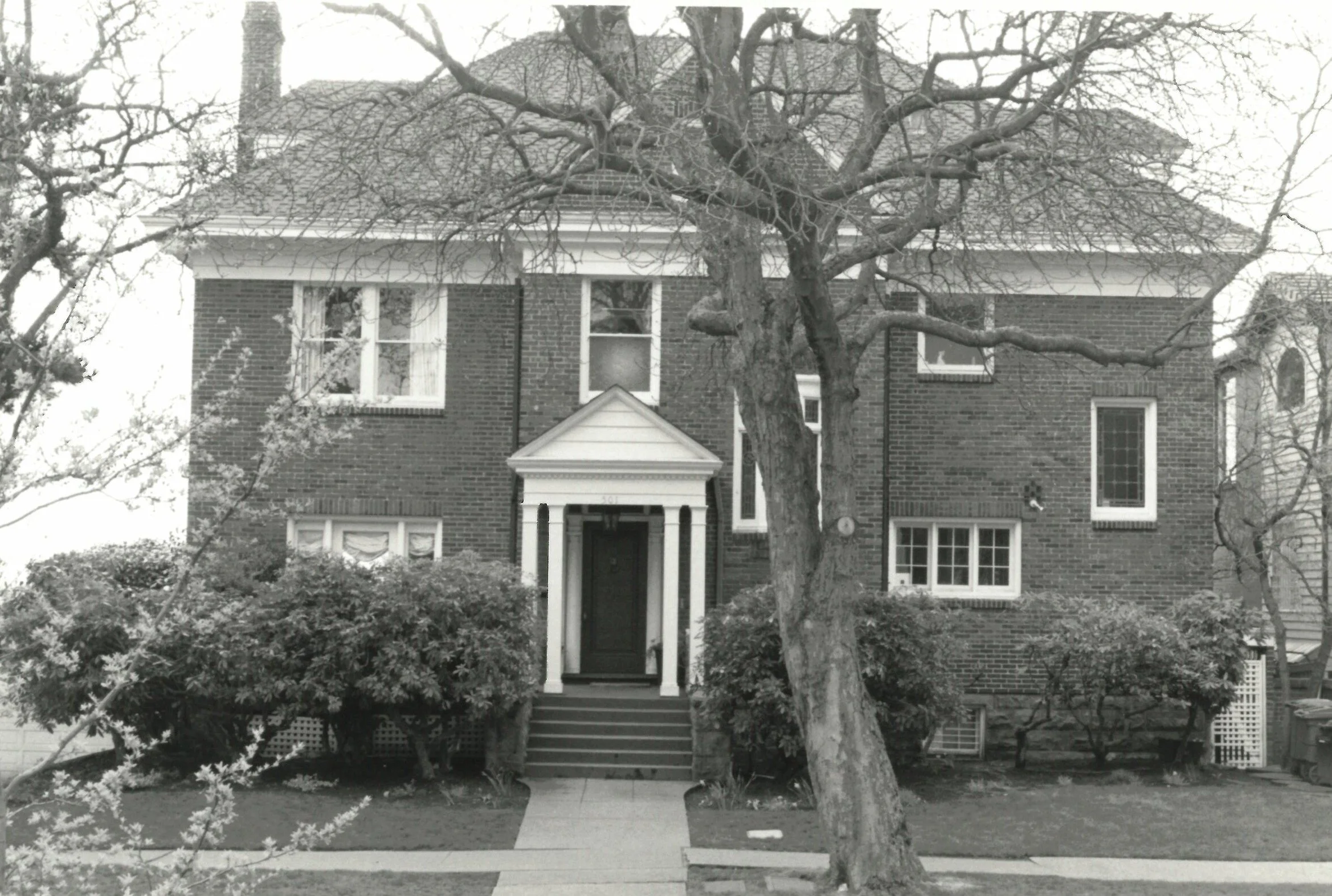
In its 2004 glory. Photo: Seattle Historical Sites. www.seattle.gov/don
While quoins, brick and the canopy at the entrance have led some people to describe the house as Georgian Revival. It really didn’t have the rigorous 18th c. symmetry most often associated with the style.
The now destroyed house was built for Harry R. (1859-1919) and Ella Maria Durgin Clise (1862-1933). Harry and his older brother JW arrived in Seattle in 1889 just after the fire that destroyed downtown Seattle. JW became a celebrated real estate mogul and assertive investor in early 20th C. Seattle businesses. Harry, who trained as a lawyer, is remembered as a champion of the publicly owned Cedar River reservoir and the pipes that still bring fresh water to Seattle. At the time he and Ella constructed the house, Harry had just founded Citizens Light and Power Company, which located its main plant off Smith Cove. Harry died in March of 1919, of a massive heart attack. Ella, who was among the high-society founders of the Sunset Club, left 501 W. Highland Drive soon after Harry’s death. By 1931, John W. Rumsey owned it. He lived there until 1940 when he moved next door into the massive Kerry house just to the east across 5th Ave W. I find it amusing that Rumsey caused a fire to the Kerry house in November 1938, as he readied it for a Halloween party which went on just the same. Much like the Clise House fire of 2021, the 1938 fire at the Kerry house largely damaged its third story.
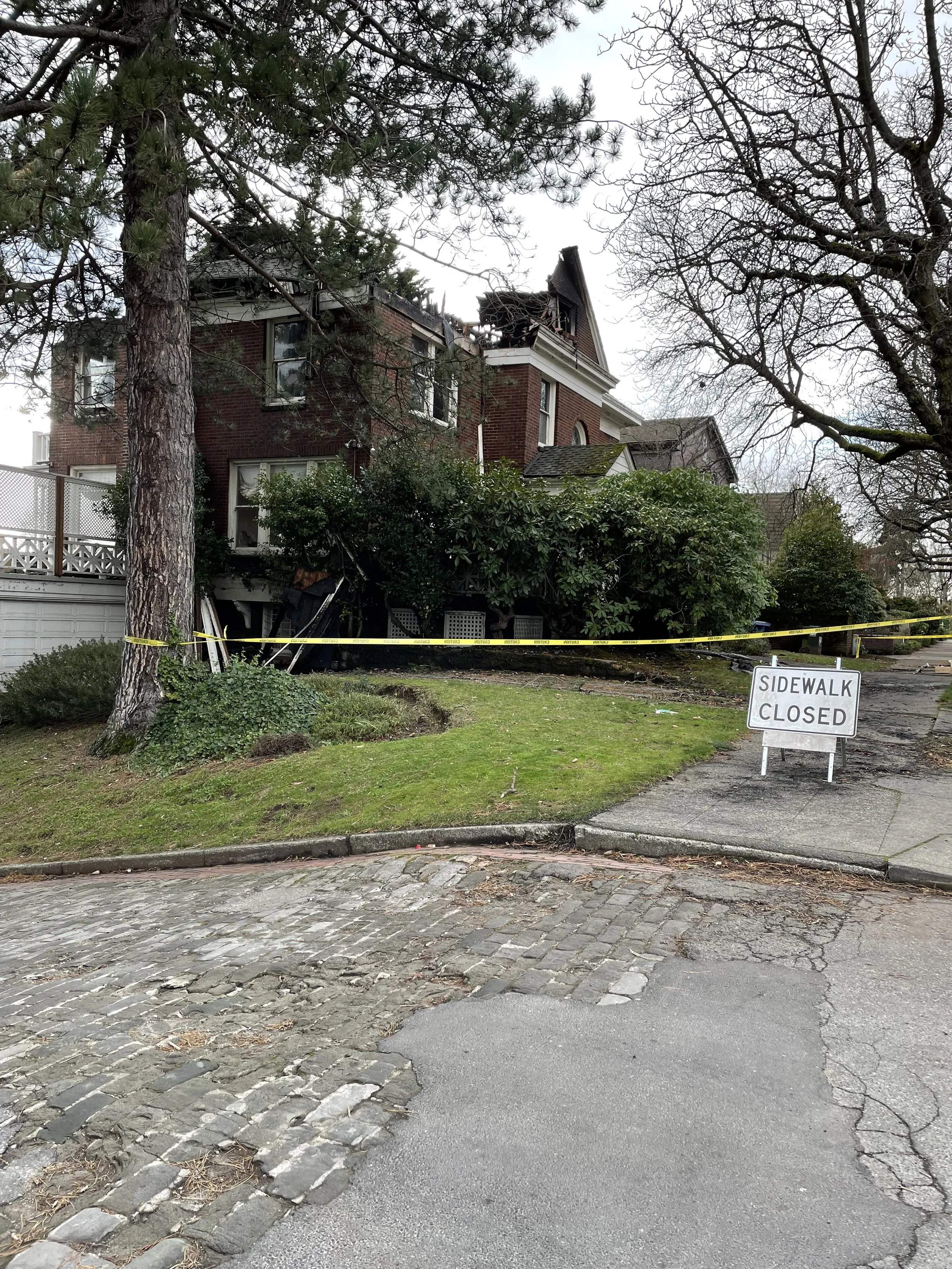
Looking sw after the fire destroyed the roof. Photo: QAHS. December 2021.
So rich is the history of fires along the snazzy street at the crest of Queen Anne hill that since January of 2026, the Seattle Fire Department used the shell of the Clise House to accumulate 300 hours of on-site training. As valuable as that may have been, I hope they don’t find a replacement any time soon.
_____________________
**Accuracy in history can be elusive. Since the publication of this Postscript in mid June, new sources of information have come to light about the Clise House story. Look for a second update and perhaps even a third in the fall of 2026. Thank you for your engagement in how we tell history as much as in the tale of a family and their home.
Sources: Seattle Daily Times, Seattle Times, Historylink.org, email exchange with current property owners, qahistory.org,