From Aetna to Warren: Queen Anne Street Names
In the 19th century, Queen Anne’s real estate entrepreneurs were free to plat and name streets as they pleased. Ultimately in 1895, our local government rationalized street names, extending them across the entire city, east to west for streets, north to south for avenues. Avenues like our Queen Anne Avenue curiously change names and sometimes disappear into shifting grids. Oddball streets such as Lorentz, Prosch, Gilman, or Humes just don’t go anywhere. It remains unclear why so many streets line up across so many plats and bodies of water, but Newton Street skips across Lake Union to Capitol Hill and the Smith Cove mud flats to Magnolia.
Aetna to Florentia Streets: These six streets in northwest Queen Anne were named in 1888 alphabetical order after locations in Italy. They all have Latin names. Aetna Street sports the name of Mount Etna in Sicily. It is Europe's largest and most active volcano. Subsumed by SPU and Wallace Field, it no longer exists. Montibello di Bertona is a small place near Abruzzo. Cremona is a town in Lombardy. The Dravus, known in Italian today as the Drava, is a river flowing southeast from the Tyrolean Alps in Italy to Hungary where it joins the Danube River. Etruria is a region in central Italy known for the Etruscans. Florentia is the name of the Roman city we call Florence. Modern Italians call it Firenze.
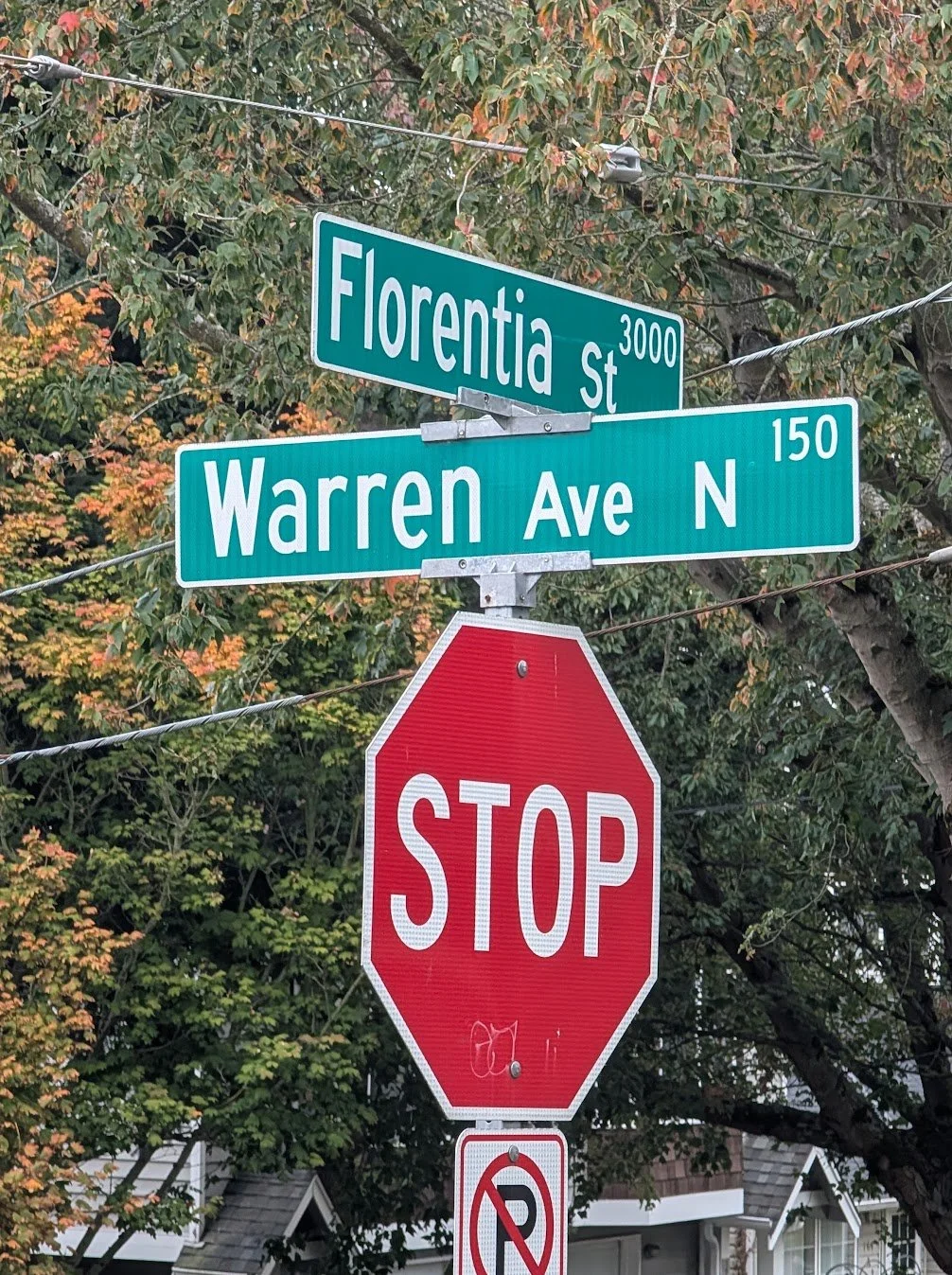
Photo: QAHS 2025.
Aloha Street: The street name was first printed on the 1875 plat of David T. Denny's Second Addition to North Seattle. It is likely a reference to the early trade links between Seattle and Hawaii. Lumber milled from trees on Queen Anne hill was sold in Hawaii.
Bigelow Avenue: Isaac Newton Bigelow (1838-1922). After a severe windstorm in 1875 blew down thousands of trees, views opened up around Queen Anne Hill. This attracted interest from real estate speculators like Isaac Bigelow, a builder-developer who bought land from the Denny and Mercer families and built houses for Seattle's growing population.
Blaine Street: We would love to think that this street is named for Catharine Paine Blaine (1829-1908). She was Seattle's first schoolteacher and the youngest signer of the 1848 Declaration of Sentiments at the Women's Rights Convention in Seneca Falls, N.Y. which demanded women's right to vote. Like other street name heroes, e.g.: McGraw and Galer, Catharine and her husband David are buried at our Mt. Pleasant Cemetery. Alas, one local historian claims the street is named for James G. Blaine, a well known Republican and one-time candidate for president of the United States. He is probably correct. After all, Catherine was a woman! Lenora, Virginia, Cleopatra, Olive and Loyal prove that around the turn of the 20th c. people used first names for streets honoring their daughters and sons (John and Ray come to mind). You know, when you think about it, Blaine wasn’t Catherine’s first last name!
Denny Way: David Thomas Denny (1832-1903). Not to be confused with his older brother Arthur, David was a real estate developer. His office, built in 1889 and known as the Denny Log Cabin was located on the southeast corner of Temperance Avenue (Queen Anne Ave.) and Republican. It survives in Federal Way. Both brothers landed at Alki Point in 1851 with the Denny party.
Dexter Avenue: Dexter Horton (1825-1904). Horton was an early settler in Seattle who came here in 1853. In 1870, he founded the city's first bank, the Dexter Horton Bank. It later became Seafirst Bank and was sold to the Bank of America in 1983.
Galer Street: Jacob Galer (1807-1840) and his wife Lydia. They were early residents of Queen Anne who built a log cabin at what is now Highland Drive and 5th Ave. N.
Kinnear Place: George Kinnear (1836-1912). Kinnear was a pioneer, real estate developer and community benefactor. He probably picked the name for the street himself. In 1888, with his wife Angie, he gave the city its second park, Kinnear Park. In 1904, he kicked off Kerry Park donating land on both sides of Prospect at 2nd Ave W.
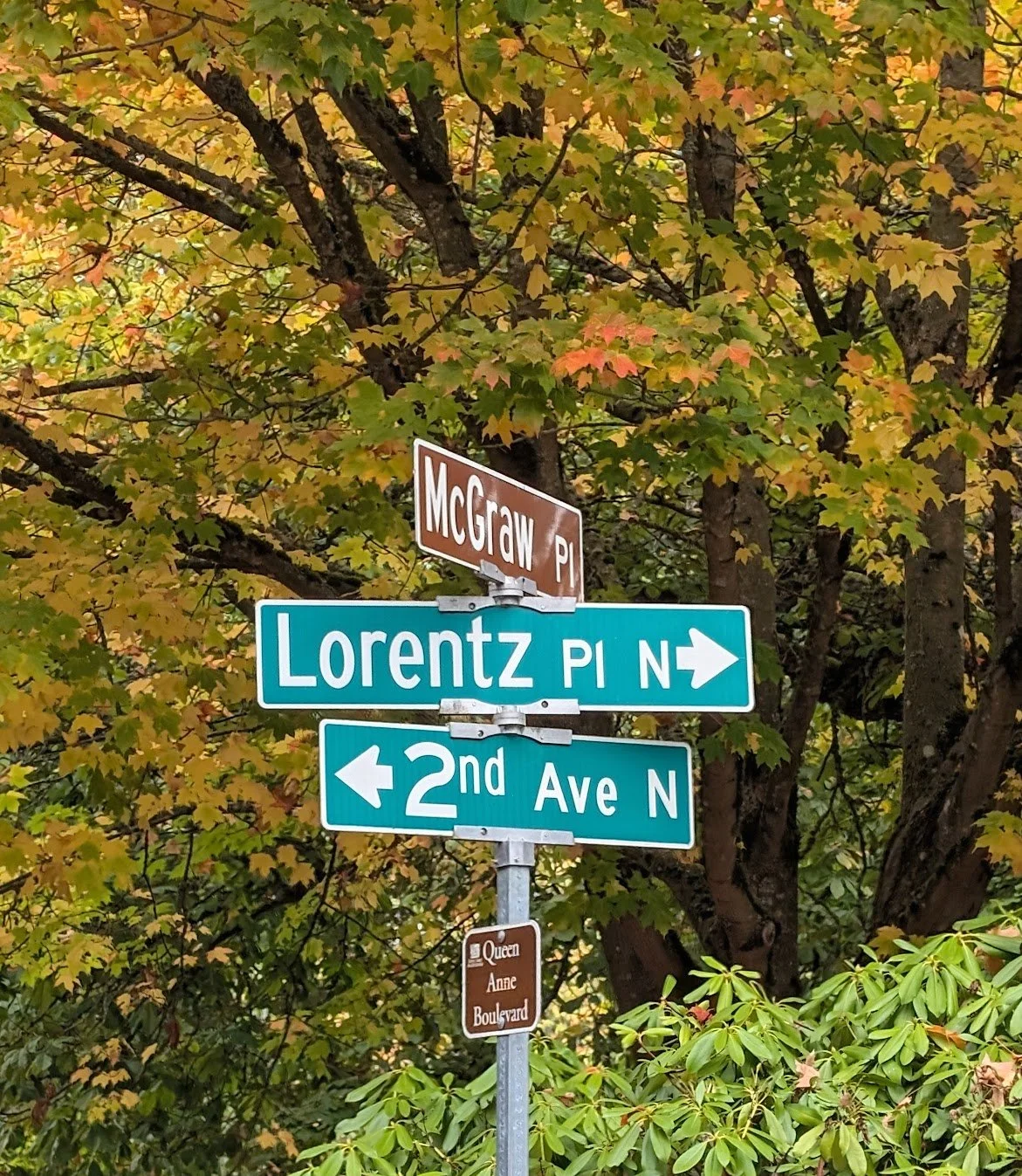
Photo: QAHS 2025.
Lorentz Place: John A. Lorentz (1879-1958). This short street runs along the western edge of Wolf Creek Ravine. Lorentz constructed all the houses on this dead end street.
McGraw Street: John Harte McGraw (1850 - 1910). McGraw served many public roles, including Governor of Washington (our second one), King County Sheriff, and Seattle Chief of Police. He notably defended Chinese laborers from a mob during the 1886 anti-Chinese riots in Seattle. He died in his home (now demolished) on Prospect Street. The site now serves as a curious empty island at Prospect and First Ave. N.
Mercer Street: Thomas D. Mercer (1813 - 1898). A Seattle pioneer who arrived in 1853, Mercer settled on a 160-acre homestead on Lower Queen Anne. A wagon road along the current Mercer Street was constructed between Lower Queen Anne and Farm Street (later Aurora Avenue) in 1885.
Newton Street: middle name of builder-developer Isaac Newton Bigelow. He probably picked it.
Nickerson Street: Alfred and Elmyra Nickerson, who platted Ross Second Addition to the City of Seattle in 1888.
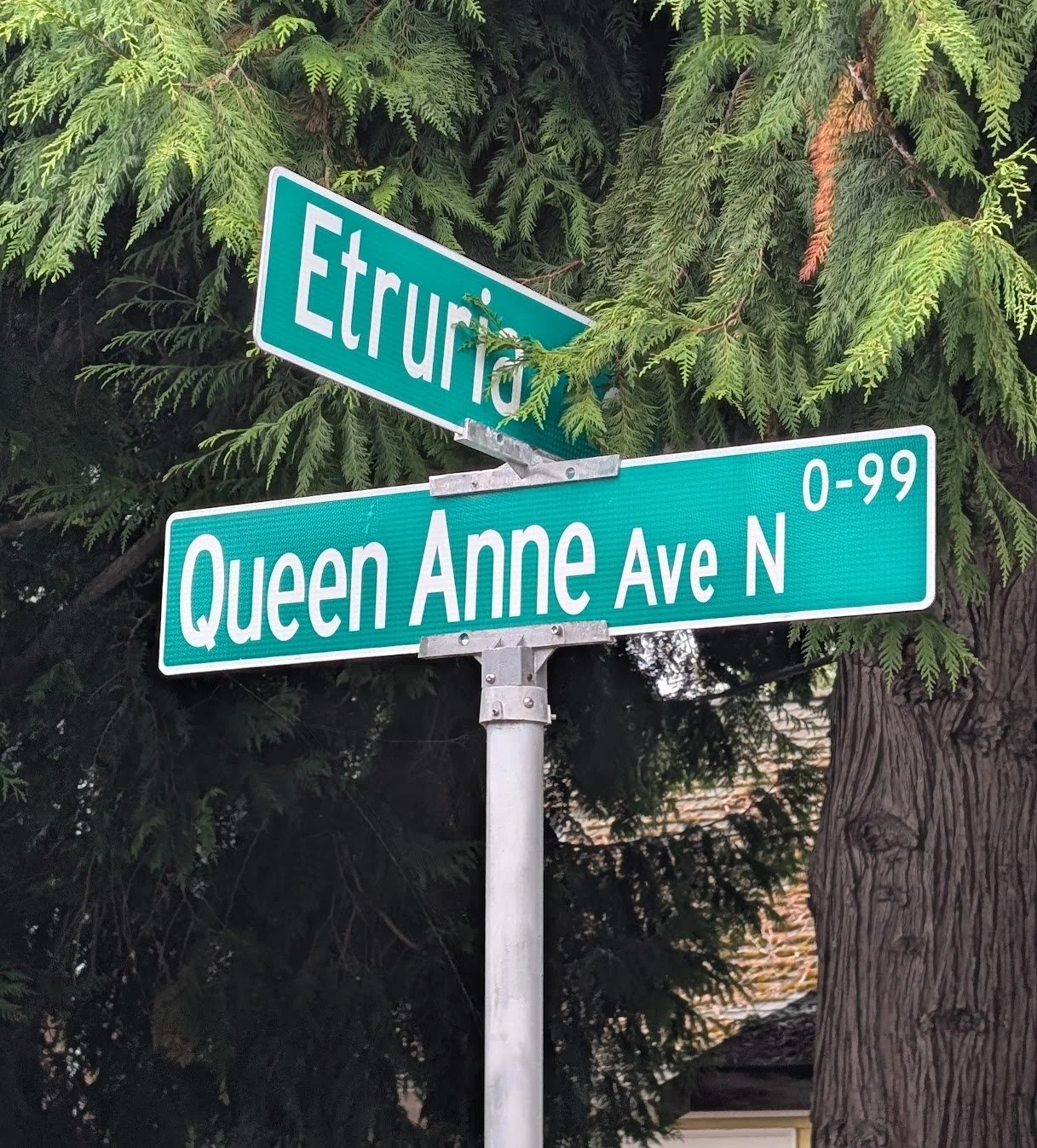
Photo: QAHS 2025.
Queen Anne Boulevard: This wonderful but curious street really isn’t one. It stitches together a number of streets with each one retaining its historic name creating a long tangle around the top of the hill. It also tells a story about power. In 1903, the Parks Commission hired the Olmsted Brothers – John Charles Olmsted (1852-1920) and Frederick Law Olmsted, Jr. (1870-1957) - to design a plan for Seattle parks. Even though the fantastic views from Queen Anne met some of their boulevard standards, the route was too narrow and convoluted to include in their final report. This infuriated a number of wealthy folks who actually lived on or near the route. They exerted their power and forced the city to add Queen Anne Boulevard to the plan. After many fractious battles to acquire the right to build the boulevard, the city completed the work in 1916. The boulevard consists of the roadway which is maintained by the city’s Department of Transportation and a city park extending ten feet to either side of the roadway which is managed by Parks and Recreation. Ironically, those power brokers made sure the park didn’t run by any elegant view homes and left out the stretch from the end of Bigelow west to Betty Bowen Overlook! Happily, the Department of Neighborhoods controls a historic landmark that runs the whole distance around the crown of Queen Anne.
Roy Street: George Kinnear’s son, Roy. (1881-1959)
Smith Street: Dr. Henry Smith (1830-1915). Our first medical doctor, he and his family owned most of Interbay. Smith Cove also bears his name.
Ward Street: Dillard B. Ward (1838-1922). Ward may have played a role in the early development of the Seattle Times and the Seattle Post Intelligencer.
Warren Avenue: Major-General Joseph Warren (1741 - 1775). He was killed at the Battle of Bunker Hill and is described as the first great martyr of the Revolutionary War.